How I'm Setting Up My Coleman 17B for Off-Grid and Emergency Use
A camper is more than a weekend toy. If the power goes out for a week, a storm hits, or you just want to camp somewhere without hookups, it can be a bed, a kitchen, a bathroom, and a heater on wheels. But a stock Coleman 17B is not set up to last long without hookups. This is my plan for setting ours up for off-grid and emergency use, what I am buying, and why. We already have the water, the spare propane, the CO detectors, the food, the first aid kit, and an emergency tool kit. The power setup and the backup heater are next on the list. I will update this post as I test it.
This post contains Amazon affiliate links. As an Amazon Associate, I earn from qualifying purchases at no extra cost to you. Some of the gear here I already own, and some is still on my to-buy list. I will update this post as I test it. Everything is in our Coleman Off-Grid and Emergency Kit list.
In this post
- How long a stock Coleman 17B lasts off grid
- Start here: the first 10 things to buy
- Water
- Power and solar
- Heat
- Food and the grab-and-go kit
- Level up: the next things to add
- Coleman 17B off-grid FAQs
How long a stock Coleman 17B lasts off grid
Not long. Here is where a stock 17B runs out first:
- Water: The fresh tank is 21 gallons. With careful use, that is roughly 2 to 4 days for a family. It is the tightest limit on the camper.
- Power: One 12V battery runs the lights, the water pump, and the furnace fan for a night or two. Our fridge runs on 12V, not propane, and it is the biggest draw on the battery, so that window gets shorter fast. If your 17B has a 2-way propane fridge, you have more time.
- Heat: The furnace burns propane, but its fan needs 12V. No battery means no heat.
- AC: It will not run on the battery at all. It needs shore power, a generator, or a big power station.
- Waste: The gray and black tanks are 34 gallons each. Gray usually fills first.
So the plan comes down to four things: more water, more power, backup heat, and a way to deal with waste.
One honest safety note: a camper is a great place to ride out a power outage, but it is not a storm shelter. For tornado warnings and severe storms, get to a sturdy building. The camper is for before and after.
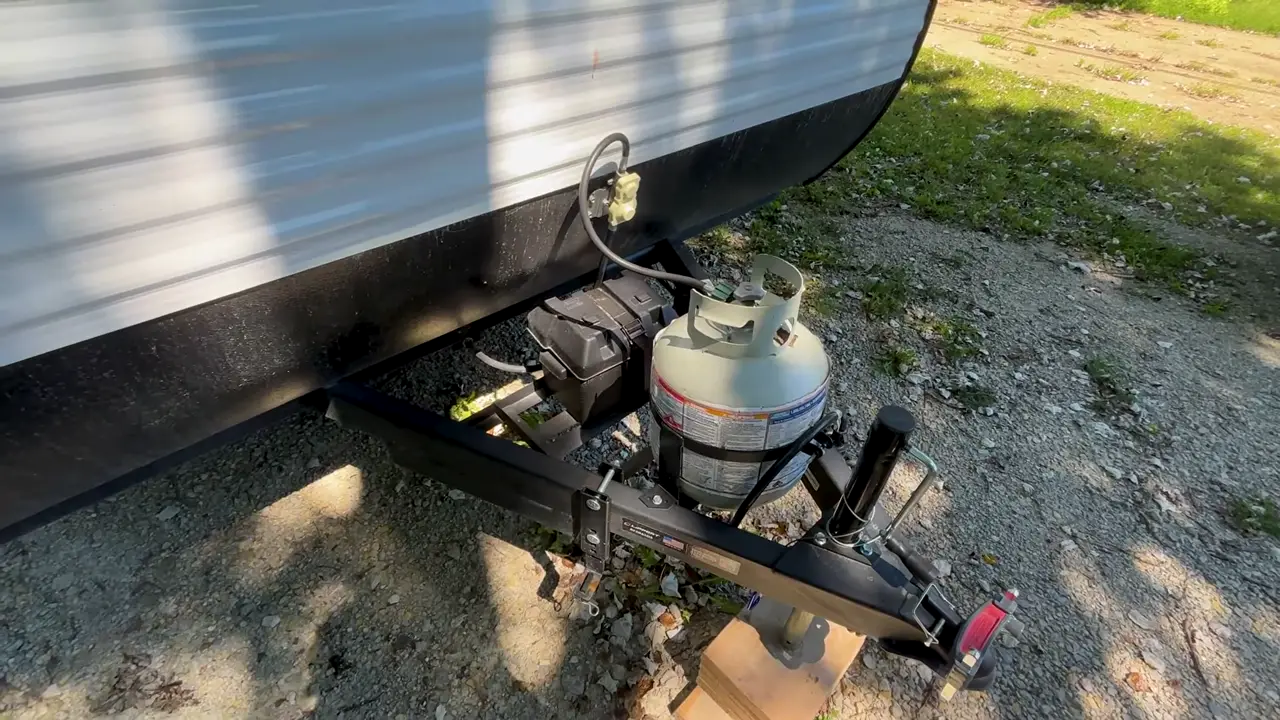
Aaron Goes Outdoors walks a Coleman 17B after a year of camping, including the propane, battery, and exterior setup.
▶ See the stock propane and battery setup in the video
Start here: the first 10 things to buy
If you only buy these, you can stretch a Coleman 17B from a day or two to a week or more.
- 7 gallon water jugs (2)
- A gravity water filter
- A big power station with solar panels
- A second 20 lb propane tank
- A Mr. Heater Buddy
- A battery-powered CO detector
- A hand crank weather radio
- Rechargeable headlamps
- Emergency food
- A first aid kit
Water
Water is the first thing you run out of, so it comes first.
- Extra jugs. We keep extra 7 gallon water jugs with the camper. Two Reliance 7 gallon Jumbo Tainers add 14 gallons on top of the 21 gallon fresh tank. If lifting a full jug is a problem, this 7.4 gallon jug with wheels rolls instead.
- A gravity filter. If the water is out or under a boil order, a gravity filter turns lake, creek, or rain water into drinking water without power or pumping. We have the Waterdrop gravity filter straw 2-pack. If it is sold out, this 6L gravity water filter bag works the same way.
- Use less. Paper plates, quick showers, and a wash basin for dishes make the tank last a lot longer than you would think.
Power and solar
This is the big one. Instead of rewiring the camper with lithium batteries and chargers, I am going with one big portable power station that can also back up the house.
The Jackery HomePower 3000 with two 200W solar panels has 3,072Wh of storage and 3,600 watts of output. That is enough to:
- Run the lights, water pump, and furnace fan for days.
- Keep our 12V fridge going through a multi-day outage, which is the main reason I went this big.
- Possibly run the AC for a short stretch. The AC pulls a lot, so expect a couple of hours, not all day. This is an estimate until I test it.
- Recharge from the sun with the two included panels, so it is not a one-time battery.
It is not cheap. The reason I like it over a camper-only setup is that it does double duty. When the power goes out at the house, it comes inside and runs the fridge, the internet, and phones.
How it connects: The 17B uses a 30 amp shore power cord. With a 30 amp to 15 amp adapter, you can plug the camper into the power station like it is a campsite pedestal. One tip: flip off the converter breaker when you do this, or the camper will spend your stored power charging its own battery.
Heat
Cold is the real danger in an emergency, so I want two ways to stay warm.
- A second propane tank. The 17B runs the furnace, stove, and fridge on propane. We keep a spare 20 lb propane tank, so we always have a full one, and a propane tank gauge tells you when to swap.
- A backup heater. This one is next on my list. The furnace needs battery power for its fan. The Mr. Heater Portable Buddy does not. It is rated for indoor use, with a low-oxygen shutoff and a tip-over switch. Still crack a window when you run it.
- A separate CO detector. Any time you burn propane inside, run a battery-powered CO detector on top of the camper’s built-in one. We have Kidde battery CO detectors for exactly that. If the camper battery dies, the built-in one can too.
Food and the grab-and-go kit
The goal is a bin that lives in the camper, so in an emergency you just grab the keys and go.
- Emergency food. We have the ReadyWise 132-serving emergency food bucket, which covers a lot more than a long weekend and stores for years. It sells out often. If it is unavailable, the 4Patriots 72-hour food kit is a smaller starter that covers a few days.
- An emergency tool kit. We keep a 262-piece survival kit with the camper. It has an axe, a shovel, a tent, and a first aid pouch in one bag, so the basics are covered if you have to leave in a hurry.
- A weather radio. The Midland ER310 gets NOAA weather alerts, charges by hand crank or solar, and can charge a phone.
- Headlamps. This rechargeable headlamp 3-pack gives everyone their own light, and you will use them on every normal trip too.
- A first aid kit. We already keep a 300-piece first aid kit in the camper. It is also in our Coleman camper must-haves.
- The rest: cash, copies of important papers, any medications, phone chargers, and a printed list of what to grab from the house.
Level up: the next things to add
These are the bigger buys, and most people get them second.
- A generator. For longer outages or running the AC all day, a Champion 2500W dual-fuel inverter generator runs on gas or propane. The Champion 4000W dual-fuel RV ready inverter gives more headroom for the AC and plugs straight into the camper.
- A soft start for the AC. A soft start cuts the power spike when the AC kicks on, so a smaller generator or the power station can handle it.
- A portable waste tote. When there is no dump station, a Camco Rhino 21 gallon tote lets you empty the gray tank and keep going.
- A tire plug kit. A flat on the way out is the last thing you need. Keep a tire plug kit and a 12V air compressor in the tow vehicle.
- A second fire extinguisher and a jump starter round it out.
Coleman 17B off-grid FAQs
How long can a Coleman 17B go without hookups?
Stock, about a day or two on battery, and roughly 2 to 4 days on water with careful use. With extra water jugs, a power station with solar, and a spare propane tank, you can stretch that to a week or more.
Can you run the Coleman 17B AC without hookups?
Not on the stock battery. You need a generator or a large power station. A soft start on the AC makes it much easier for a smaller generator to handle.
Can a portable power station run a camper?
Yes. A large one can run the lights, water pump, furnace fan, and a 12V fridge for days, and solar panels can recharge it. Running the AC drains it fast.
Can you plug a camper into a regular house outlet?
Yes, with a 30 amp to 15 amp adapter. A standard outlet will run the lights, fridge, and charge the battery, but it is not enough to run the AC and other big loads at the same time. The same adapter works for plugging the camper into a power station.
How much solar do you need to run a camper?
It depends on what you run. For lights, the water pump, phone charging, and a 12V fridge, a few hundred watts of panels feeding a good battery is a solid start. The Jackery bundle I am planning on comes with 400 watts. Running the AC on solar alone takes far more panels and battery than a small camper can carry.
Can you run an RV air conditioner on solar power?
Not practically on a small setup. A camper AC pulls a lot of power, so even a big power station only runs it for a short stretch, and a few portable panels cannot keep up. For all-day AC off grid, use a generator.
Is a camper safe in a storm?
No. A camper is not a storm shelter. During tornado warnings or severe storms, get to a sturdy building. Use the camper for power outages and the days before and after a storm.
Is it safe to use a Mr. Heater Buddy in a camper?
It is rated for indoor use and has a low-oxygen shutoff and a tip-over switch. Crack a window for fresh air and always run a battery-powered CO detector with it.
What should be in a camper emergency kit?
Extra water and a filter, a power source, backup heat, a CO detector, a weather radio, headlamps, food for at least 72 hours, a first aid kit, and copies of important papers.
Final thoughts
A camper is one of the best emergency plans you can own, but only if it is ready before you need it. Start with water, power, and heat, then build out the rest. I will update this post as I test the setup, including how long the power station actually runs our 17B.
Everything above is in our Coleman Off-Grid and Emergency Kit list. For the everyday gear, see our Coleman camper must-haves, and keep the camper ready with our guide to checking a Coleman for water leaks. For more, subscribe to Aaron Goes Outdoors on YouTube.