Coleman 17B Specs, Weight, and What Tows It (From an Owner Who Tows One)
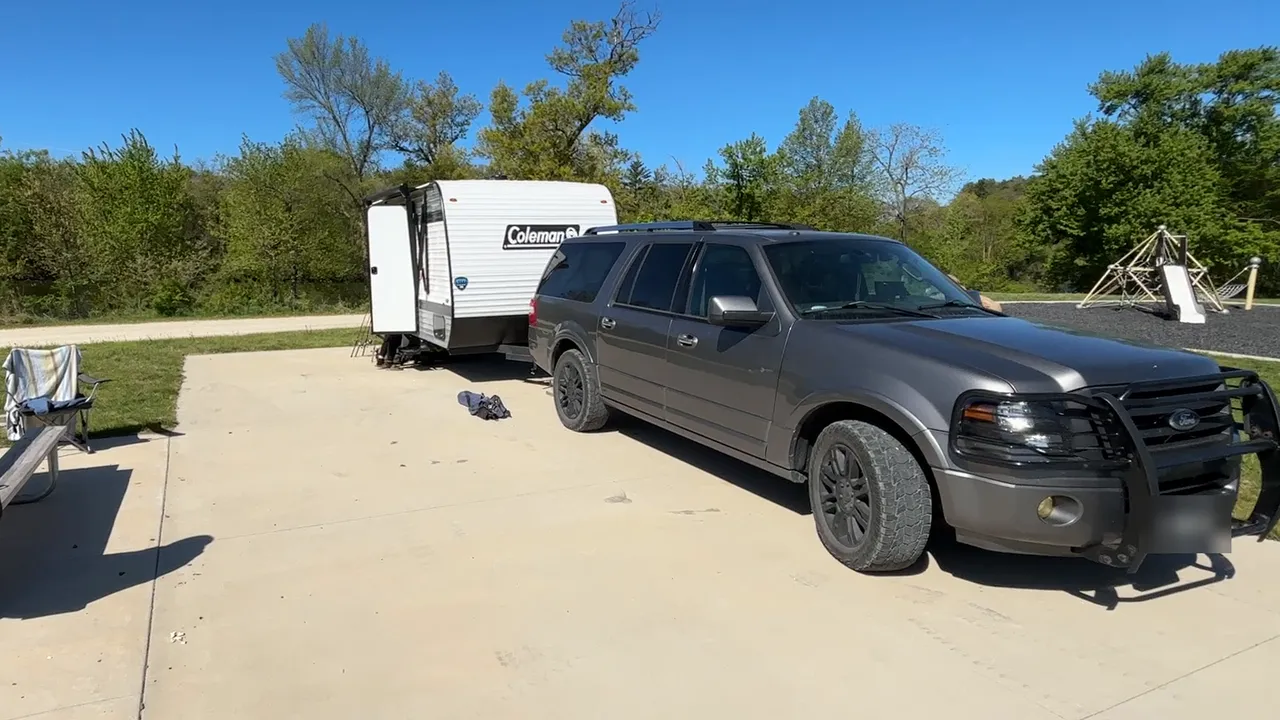
If you are shopping for a Coleman 17B, the numbers that matter most are how long it is and how much it weighs, because those decide what can tow it. Here is every spec in one place, checked against Keystone’s own spec sheet, plus how we tow ours: a 2012 Ford Expedition with its built-in brake controller and a Curt weight distribution hitch. We have put over 2,000 miles on our 2025 17B so far.
Have a 2024 or older Coleman Lantern LT 17B? Those were built by Dutchmen, not Keystone, and the numbers are different (about 21 feet 5 inches long and 2,985 pounds dry). Here is what changed between the Lantern LT and the Keystone 17B.
In this post
- The short answer
- Watch our 17B walkthrough
- Full Coleman 17B spec sheet
- Dry weight vs GVWR: which number to use
- What it takes to tow a Coleman 17B
- Our tow setup: 2012 Ford Expedition
- The hitch and brakes you need
- Check the stickers on your own 17B
- Coleman 17B specs FAQs
The short answer
The Keystone Coleman 17B is 20 feet 2 inches long and 9 feet 5 inches tall. It weighs 3,071 pounds empty from the factory and has a 4,300 pound GVWR, the most it is allowed to weigh fully loaded. The hitch weight is 398 pounds empty. It is a single axle trailer that sleeps five.
To tow it comfortably, most people go by the 80% rule: keep the camper’s GVWR at or under 80% of your vehicle’s tow rating. For the 17B, that means a tow rating of about 5,400 pounds or more, plus enough payload for the tongue weight and everyone in the vehicle. Our towing calculator has the 17B built in and checks both for you.
Watch our 17B walkthrough
Aaron Goes Outdoors walks through our 2025 Coleman 17B, inside and out, so you can see the size in person.
Full Coleman 17B spec sheet
These are Keystone’s published numbers for the 17B, from its Coleman 17B spec page, with a few notes from owning ours.
| Spec | Coleman 17B |
|---|---|
| Length | 20 ft 2 in |
| Exterior height | 9 ft 5 in |
| Interior height | 78 in (6 ft 6 in) |
| Dry (shipping) weight | 3,071 lbs |
| Cargo carrying capacity | 1,229 lbs |
| GVWR | 4,300 lbs (dry weight plus cargo capacity) |
| Hitch weight (empty) | 398 lbs |
| Axles | Single axle, electric brakes (ours is rated 4,000 lbs) |
| Tires | ST215/75R14, load range D (65 PSI cold, per our label) |
| Spare tire | Optional. Ours did not come with one. |
| Fresh water tank | 21 gallons |
| Gray water tank | 34 gallons |
| Black water tank | 34 gallons |
| Propane | One 20 lb tank |
| Water heater | 42,000 BTU Suburban tankless (ours is an ST-42) |
| Furnace | 20,000 BTU |
| Air conditioning | 5,000 BTU sidewall unit up by the bed |
| Fridge | 3 cubic foot, 12V |
| Kitchen | 2-burner gas range and a microwave |
| Awning | 8 ft power awning with LED lights |
| Electrical | 30 amp |
| Sleeps | 5 (60 x 74 in queen, bunks, and a dinette that converts to a bed) |
Keystone notes that its website reflects the most recent production run and that specs can change during the year. So use this table to shop, and use the stickers on the actual camper as the final word. More on those below.
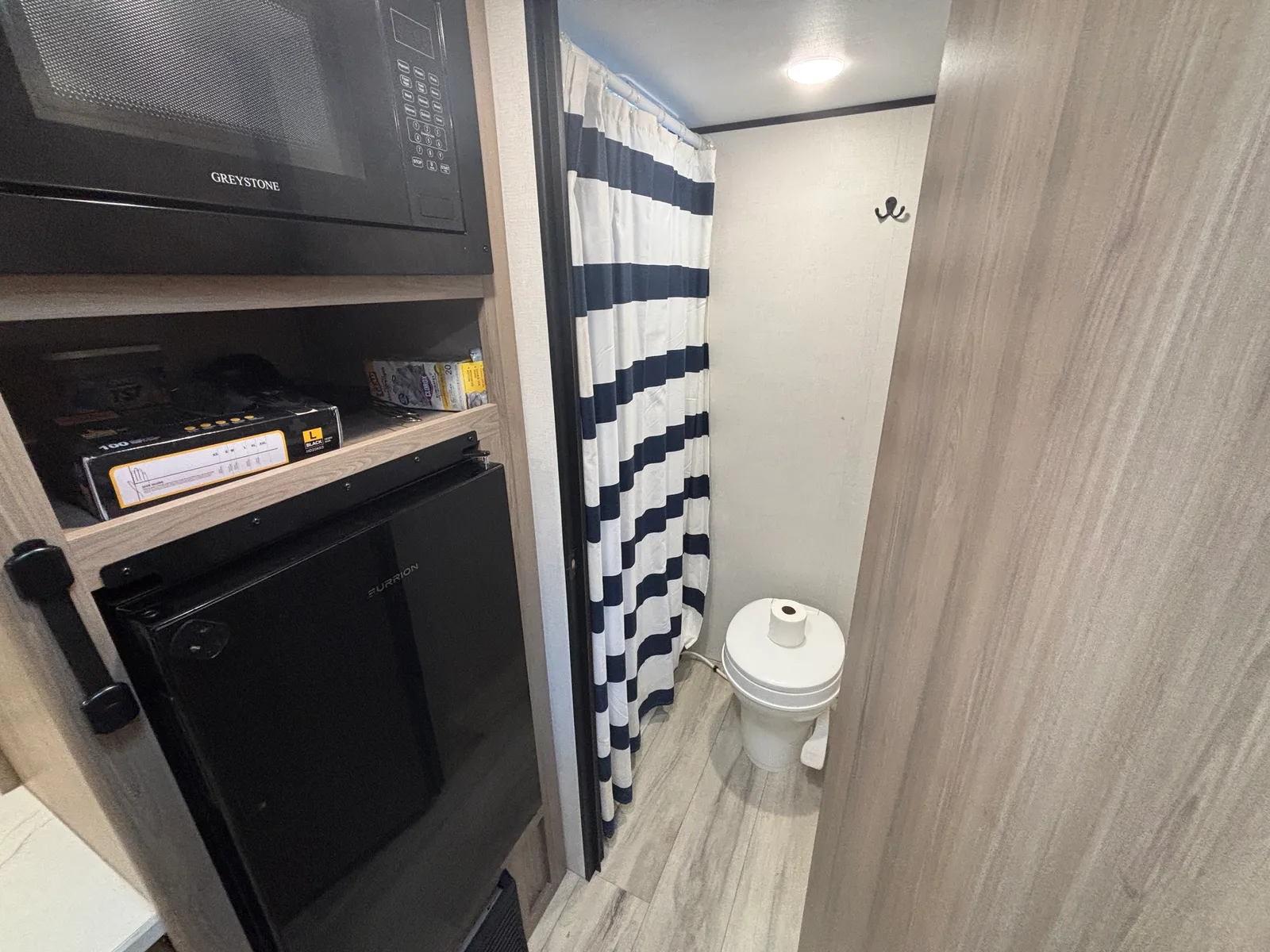
A couple of these are worth knowing from experience. The 21 gallon fresh tank is the tightest limit on the camper when you are off hookups, which is why we carry extra water jugs. And the AC is a window-style unit in the wall, not on the roof, which is why it can drip inside if the camper sits at the wrong angle.
Dry weight vs GVWR: which number to use
Use the GVWR, not the dry weight, when you check your tow vehicle.
Dry weight is the camper empty from the factory: no propane, no battery, no water, no food, no gear. Nobody tows it like that. Our camper’s label lists a full fresh water tank at 174 pounds, and that is before you pack a single bag. Add propane, a battery, bedding, dishes, food, chairs, and toys, and the weight climbs fast.
The biggest lesson from towing ours: the camper always ends up heavier than the brochure’s dry weight. The GVWR builds in that margin. If your vehicle can handle 4,300 pounds behind it, you are covered no matter how you pack, as long as you stay under the 1,229 pound cargo capacity.
What it takes to tow a Coleman 17B
There are two numbers to check on your vehicle, and both are in the owner’s manual or on the sticker in the driver’s door jamb.
- Tow rating. At the 80% rule, 4,300 pounds of camper calls for a tow rating of about 5,400 pounds or more. Going over 80% can work, but it leaves less margin for hills, wind, and a heavy load.
- Payload. This is the one people miss. The camper’s tongue weight presses down on your hitch, and it counts against your vehicle’s payload along with every person, pet, and cooler inside. The 17B’s tongue weight is 398 pounds empty, but loaded tongue weight usually runs 10 to 15% of the trailer’s weight. At 4,300 pounds, that is about 430 to 645 pounds. A weight distribution hitch adds roughly another 75.
Plenty of SUVs and half-ton trucks run out of payload before they hit their tow rating. Plug your own numbers into our camper towing calculator to see where you land.
If your vehicle comes up short, look at the smaller Coleman 13B. It is about 16 feet long with a 3,500 pound GVWR. Here is our Coleman 13B vs 17B comparison.
Our tow setup: 2012 Ford Expedition
We tow our 17B with a 2012 Ford Expedition. It has a factory brake controller built into the dash, and we added a Curt weight distribution hitch with sway control.
Ford rated the 2012 Expedition to tow up to 9,200 pounds with its optional heavy-duty trailer tow package, or up to 8,900 pounds for the longer Expedition EL. Either way, the 17B’s 4,300 pound GVWR is less than half of that. It tows easily. Our biggest trip so far was to Mackinaw Mill Creek Camping for Mackinac Island, roughly 500 miles each way, and it did great.
Gas mileage: we get about 8 to 9 miles per gallon towing the 17B, so plan your fuel stops on long trips.
The one thing we would pass along: keep an eye on the camper’s tire pressure. Our label calls for 65 PSI cold. The tires have held up fine over 2,000 miles, but they are the thing to watch.
The hitch and brakes you need
A weight distribution hitch. The 17B does not come with one. Ours did not, so we bought the Curt separately after our $13,499 out-the-door price. A weight distribution hitch spreads the tongue weight across the axles of your vehicle and the camper, so the back of your vehicle does not sag, and its sway control helps keep the camper steady in wind and when trucks pass.
In some states it is the law. Iowa requires brakes on trailers of 3,000 pounds or more, and a weight-equalizing hitch with sway control too, unless a truck is doing the pulling (Iowa Code 321.430). Our 17B is over 3,000 pounds before we load a thing, and we tow with an SUV. Check the rules in your state.
A brake controller. The 17B has electric brakes, and something in your vehicle has to run them. Our Expedition has one built in. If yours does not, an add-on unit runs about $85 to $205, and premium wireless models cost more. Our new camper starter guide has the full list of what to budget for beyond the camper itself, including a spare tire, since the 17B does not come with one.
Check the stickers on your own 17B
A spec sheet covers every 17B. The label on your camper covers yours: what that exact unit weighed when it left the factory, its axle rating, and its tire pressure. Ours is on the outside of the camper, with the yellow tire and loading sticker right below it.
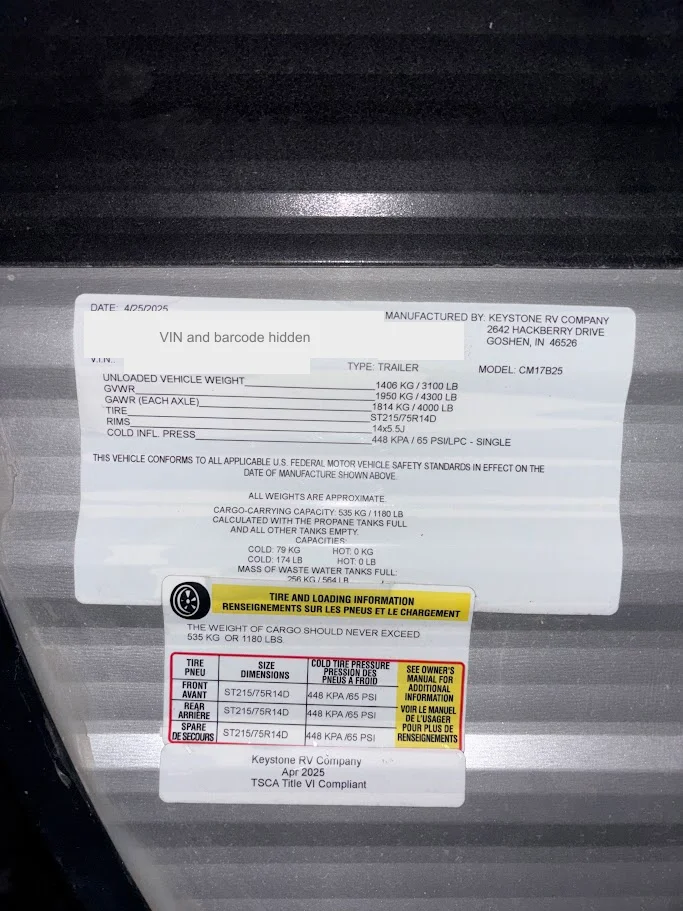
Here is how ours compares with Keystone’s published numbers:
| Keystone’s spec sheet | Our 17B’s label | |
|---|---|---|
| Dry (unloaded) weight | 3,071 lbs | 3,100 lbs |
| Cargo carrying capacity | 1,229 lbs | 1,180 lbs (with the propane tank full) |
| GVWR | 4,300 lbs | 4,300 lbs |
| Axle rating | Not listed | 4,000 lbs |
| Tires | ST215/75R14D | ST215/75R14D, 65 PSI cold |
Ours came out 29 pounds heavier than the spec sheet, and its cargo capacity is 49 pounds lower because the label counts a full propane tank. Small differences, but they show why the label is the number to trust.
A few other things on the label are worth knowing:
- The axle is rated for 4,000 pounds, 300 less than the GVWR. On a fully loaded camper, the rest rides on your hitch as tongue weight.
- A full fresh water tank weighs 174 pounds, and full gray and black tanks weigh 564 pounds. Dump before you drive when you can.
- Hot water capacity reads 0 pounds, because the tankless water heater does not store any water.
The only way to know what your loaded camper actually weighs is to weigh it. A CAT scale at a truck stop gives you the real number for a small fee.
Coleman 17B specs FAQs
How long is a Coleman 17B?
Keystone lists the Coleman 17B at 20 feet 2 inches long. The older Dutchmen-built Coleman Lantern LT 17B was longer, at about 21 feet 5 inches.
How much does a Coleman 17B weigh?
Keystone lists a dry (shipping) weight of 3,071 pounds, a cargo carrying capacity of 1,229 pounds, and a GVWR of 4,300 pounds. The label on our 2025 lists 3,100 pounds unloaded. Loaded for a trip, it will weigh well over the dry weight.
What is the hitch weight of a Coleman 17B?
Keystone lists 398 pounds empty. Loaded tongue weight usually runs 10 to 15% of the trailer’s weight, so plan on about 430 to 645 pounds when it is fully loaded.
How tall is a Coleman 17B?
It is 9 feet 5 inches tall on the outside, per Keystone, with a 78 inch (6 foot 6 inch) interior height.
What size tires does a Coleman 17B have?
Keystone lists ST215/75R14 tires, load range D, and the label on ours calls for 65 PSI cold. A spare tire is optional, and ours did not come with one.
What size AC does the Coleman 17B have?
Ours has a 5,000 BTU sidewall unit, a window-style AC built into the wall up by the bed instead of on the roof.
How big are the tanks on a Coleman 17B?
The fresh water tank is 21 gallons, and the gray and black tanks are 34 gallons each. It carries one 20 pound propane tank.
What can tow a Coleman 17B?
By the 80% rule, a vehicle with a tow rating of about 5,400 pounds or more, with enough payload for the tongue weight and everyone riding along. We tow ours with a 2012 Ford Expedition and get about 8 to 9 miles per gallon. Check your own vehicle with our towing calculator.
Do you need a weight distribution hitch for a Coleman 17B?
It is a good idea, and in some states it is the law. Iowa requires one with sway control on trailers of 3,000 pounds or more unless a truck is doing the pulling, and the 17B is 3,071 pounds empty. Ours did not come with one, so we bought a Curt with sway control.
Does the Coleman 17B have electric brakes?
Yes. It is a single axle trailer with electric brakes, so your tow vehicle needs a brake controller. Our Expedition has one built in.
Final thoughts
The Coleman 17B is one of the lighter bunkhouse trailers out there, but light is relative. Plan around the 4,300 pound GVWR, not the dry weight, check your payload as well as your tow rating, and budget for a weight distribution hitch and a spare tire. Do that and it is an easy camper to tow. Ours has been.
Still deciding which Coleman fits your family and your tow vehicle? Take our 5-question Coleman quiz, or compare the 17R vs the 17B. For what it is like to own one, read our six-month owner review and our one-year review. Want to try one without towing it at all? You can rent ours here in Cedar Falls, and we deliver it.
For more 17B content and honest trip reports from the Midwest, subscribe to Aaron Goes Outdoors on YouTube.